When we last left our heroes, they had roast the beans, then some better beans, then tested their grinder and were finally promising to actually make the damned coffee.
We take you now to the final installment: Actually Making the Damned Coffee.
These are some Very Important Points that dictate how we do this:
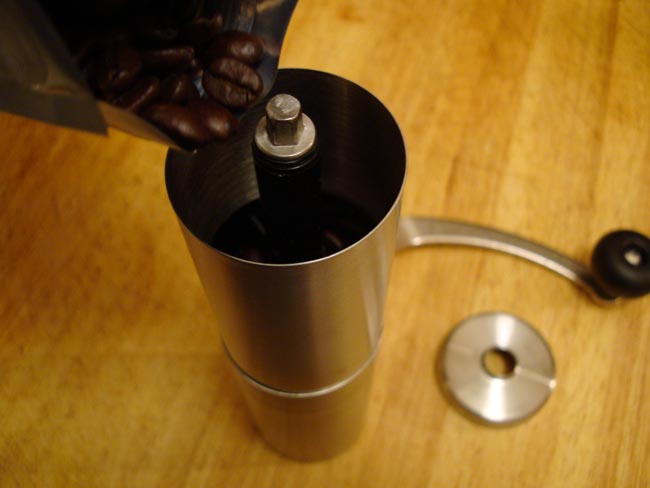
 Twenty-eight grams of Honduran beans from Kafka's. Their beans come from Hermiker, and the roaster's notes are here. They were roast 5 days before we bought them. The bag looks beat-up because we re-used it. Long story, nvmd.
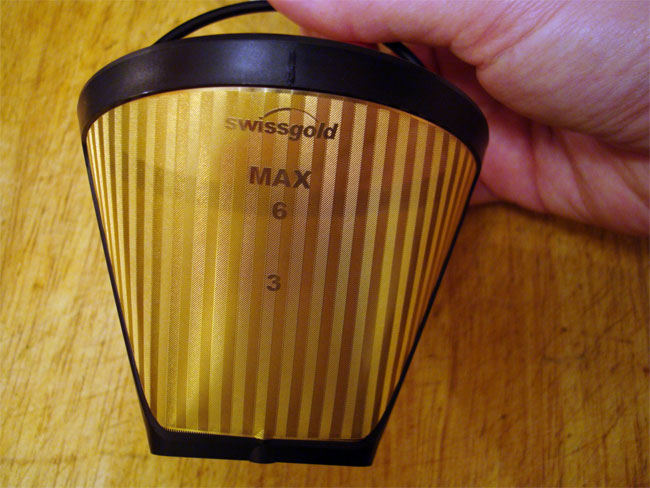
 One of the coffee-related gifts we gave ourselves this Christmas is a Swissgold filter basket. While gold isn't chemically inert, it doesn't react with the colloidal* flavour particles in the coffee. A paper filter absorbs them, but this one lets them through.
Some people like the extra particles and oils that the Swissgold filter allows into your brew, but others don't.
We have tested this filter against two kinds of paper filters and with three different kinds of beans: Honduran, Nicaraguan and Costa Rican. We prefer the Honduran in the gold filter and the others in paper.
Gah. This is taking so long! I just want a cup of coffee, not a Wikipedia article!
 The set-up: coffee pot, pour-over cone, filter basket. A ceramic pour-over cone would be nice, but it needs to be pre-heated and is not essential.
 Grind dem beans, dem beans!

Grounds in the basket.
 Pre-heat the pot in the microwave.
 A folded towel insulates the scale against the hot coffee. Probably not an issue, but it also makes a firm base for the tower of equipment.
We use the i-Pod's built-in timer, but you can also get some helpful apps specifically made for brewing coffee. We started with a free one from Intelligentsia Coffee. They also have helpful brewing guides in the app and on-line (PDF). We did notice that they never actually say how many cups each method makes, which could lead to some embarrassing situations. This specific site is a great resource for brew methods, too.
 Another coffee-specific Christmas gift to ourselves: a fancy-panty kettle with a spout designed for a slow, controlled pour. We have found that 455 grams of water ends up with just the right amount of water for our coffee if we take it off the boil right away.
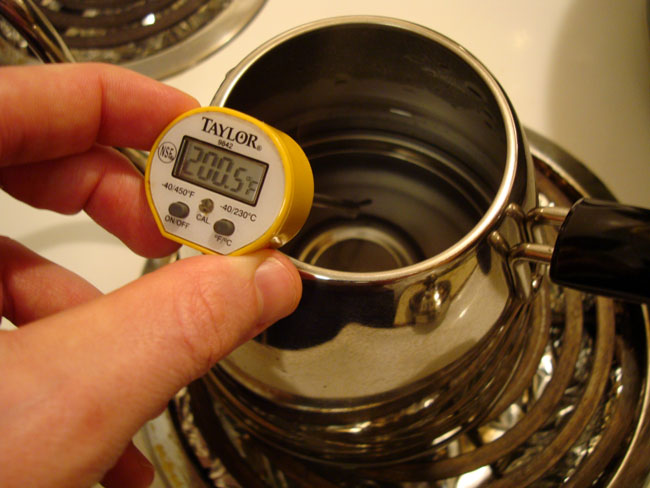
 Most pour-over methods suggest a water temperature between 195 and 205 degrees Fahrenheit. This is one of the rare occasions where we prefer to use Fahrenheit since the smaller increments allow for greater control.
 At last! Pouring the hot water! Only 65 grams to start, though; just enough to soak the grounds.
 The "bloom" will rise and let the grounds release their CO2. Coffee that was roasted less than a week before needs to rest for at least 60 seconds at this point. Coffee older than 7 days can rest for less time, but not less than 30 seconds.
During the bloom/rest, the kettle is returned to a low burner, heating back up to the magic temperature range again.

When the bloom is finished we start the final pour: s-l-o-o-o-w-l-y, in circular motions, keeping the water level constant, soaking all the grounds and staying clear of the edges.
 s-l-o-o-o-w-l-y
 The pour should take two full minutes.
 For 28 grams of coffee the added water should be about 415 grams. We poured a little too much here while fiddling with the camera. (We don't want to spoil the ending for you, but things worked out just fine.)
 The Swissgold filter is a bit fragile, we hear, so we gently tap out the grounds before giving it a good rinse.
 At long last, we pour from the pot into mugs that were pre-heated in the microwave.
 Some people think that anything added to coffee adulterates the taste,
but there are so many ways to enjoy it. We have it black for a week or
two, then with a little milk or cream. Different beans and roasts
show variations on their flavour profiles with each style. We have
dropped sugar completely, however, and it's wonderful.
Some people think that anything added to coffee adulterates the taste,
but there are so many ways to enjoy it. We have it black for a week or
two, then with a little milk or cream. Different beans and roasts
show variations on their flavour profiles with each style. We have
dropped sugar completely, however, and it's wonderful.
Now that we have this method down, do we do this every day? Absolutely not. We still love our little stove-top moka pot/caffettiera and a microwaved mug of milky instant coffee is a real pleasure.
The fun is in trying a new system and dialing in the variables and the process until you can get a reliable brew. Trying different beans and roasts is just like discovering new wines; when you get it right they reveal all kinds of wonderful flavours.
Not everyone is happy about the rise of the pour-over method, though, especially as a business model.
*Murano Glass is another example of a colloid, which coincidentally has gold chloride added to create its signature ruby colour.
We take you now to the final installment: Actually Making the Damned Coffee.
These are some Very Important Points that dictate how we do this:
- coffee freshness
- how much coffee
- what kind of filter
- how much water
- water temperature
- timing

Some people like the extra particles and oils that the Swissgold filter allows into your brew, but others don't.
We have tested this filter against two kinds of paper filters and with three different kinds of beans: Honduran, Nicaraguan and Costa Rican. We prefer the Honduran in the gold filter and the others in paper.
Gah. This is taking so long! I just want a cup of coffee, not a Wikipedia article!


Grounds in the basket.


We use the i-Pod's built-in timer, but you can also get some helpful apps specifically made for brewing coffee. We started with a free one from Intelligentsia Coffee. They also have helpful brewing guides in the app and on-line (PDF). We did notice that they never actually say how many cups each method makes, which could lead to some embarrassing situations. This specific site is a great resource for brew methods, too.



During the bloom/rest, the kettle is returned to a low burner, heating back up to the magic temperature range again.

When the bloom is finished we start the final pour: s-l-o-o-o-w-l-y, in circular motions, keeping the water level constant, soaking all the grounds and staying clear of the edges.


Now that we have this method down, do we do this every day? Absolutely not. We still love our little stove-top moka pot/caffettiera and a microwaved mug of milky instant coffee is a real pleasure.
The fun is in trying a new system and dialing in the variables and the process until you can get a reliable brew. Trying different beans and roasts is just like discovering new wines; when you get it right they reveal all kinds of wonderful flavours.
Not everyone is happy about the rise of the pour-over method, though, especially as a business model.
*Murano Glass is another example of a colloid, which coincidentally has gold chloride added to create its signature ruby colour.