Showing posts with label bean. Show all posts

April 16, 2012

Kyoto Trains

Further on the Japanese railway theme, we saw these two posters in Kyoto in October, celebrating the 30th anniversary of the Kyoto City Subway.


Embroidering the trains onto "gama-kuchi" (frog-mouth) purses cleverly ties the subway system to Kyoto's history.

These are just adorable:


Yōkan (羊羹) is a thick jellied dessert made of red bean paste, agar, and sugar. It is usually sold in a block form, and eaten in slices. Kyoto is famous for it.

From the low number of views, it seems that not many people were interested in the train videos in our post a week ago. To show that we don't cave to popular opinion (or lack of it) here are two more.

A view of Kyoto rooftops on the way to Arashiyama (25 seconds)


Going from Osaka station to Shin-Osaka, the first leg of the trip from Osaka to Kyoto. We cross the huge Yodo-gawa river at 55 seconds (2:32):

For anyone who made it this far, click the map below to see the distance and route covered (blue line):


View Osaka to Shin-Osaka in a larger map

Okay, no more trains. Back to food and wine for a while.

January 16, 2012

Porlex Coffee Mill

There are so many factors that go into finessing a better cup of coffee from your beans, and things can quickly spiral out of control into esoteric details and eye-watering expense.

One example: your coffee grinder. If you have one it's probably because you realize that pre-ground coffee quickly goes stale and that fresh-ground coffee greatly improves the flavour of your morning cup.

Traitor.

You may be as surprised as we were to find out that your reliable little $20 whirring-blade grinder is secretly acting against you, messing up your precious beans by chopping them unevenly.

So what? So when you add hot water the smaller pieces get "over-extracted" and larger pieces get "under-extracted". These quickly become very important terms when improving your coffee-making, and no, they don't average each other out.

A burr grinder works like a pepper mill, crushing beans between two rotating cones, and producing a nice, even grind which is essential for a good brew. This is what they use at your local café and why your nice, relaxing cup of coffee there is regularly interrupted by a mechanical, screeching aural assault.

If you start doing research on burr grinders you will find surprising things like this:
Spend at least the same amount on the grinder as you do on the espresso machine...
And shocking things like this:

The Espresso Parts' Mazzer Robur Competition Model: $3,564.00 


(That is only a grinder. You still need something to make the coffee.)


You may remember a post we made about Aya's Turkish coffee grinder. Some notable Japanese companies have been improving on that basic model and we recently bought one from Porlex.


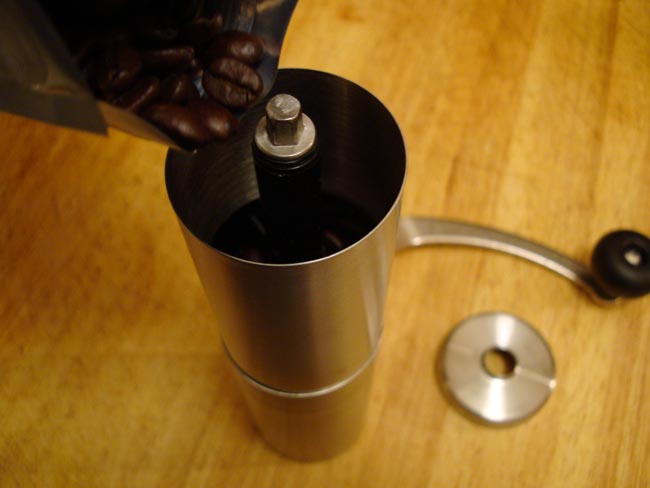
Porlex Ceramic Coffee Mill


 Beautifully simple.


The deep grooves in the ceramic cone draw the beans in towards the relentless teeth.
Who can save them? No-one! This is their terrible fate.

Let's try with me!

The long handle transferred lots of power to the mechanism, making quick work of our test batch, and producing a consistent sand-like grind.

The four-pointed adjustment nut controls the fineness.

Not had enough yet? Here's a review of the Porlex, comparing it to others by Hario, at Sweet Maria's (another excellent coffee site).


Next time: can we please just have a cup of coffee now?

January 9, 2012

Coffee Roasting: Better Beans

You might remember our first attempt at roasting coffee in an air pop-corn popper.

Finding better quality, green coffee beans turned out to be a bit of a challenge. We heard that Continental Coffee on Commercial Drive and JJ Beans on Powell Street sell some, but we decided to try Milano, whose delicious roasting aromas sweeten our neighbourhood air each week.


Milano doesn't sell green beans, but when we told their head roaster, Brian Turko, what we wanted to do, he was very helpful. He showed us around their roasting room and packed us a one-pound bag of beans from Nariño, Colombia.

Brian also gave us good roasting advice, telling us to stop the roast between four and five minutes, or just after second crack.

Following instructions on this helpful website, we measured out about 125 grams of beans.

We picked out all the ones that looked weird.

We were worried about the colder weather cooling down the air popper. It is only a 1200 Watt engine, which is 20% smaller than the 1500 Watt machine recommended on that other website. The air intake is on the bottom of the machine, so to stop cold air coming in and cooling the roast, we put the popper in a big paper bag. This recirculated the air very well. Almost too well, actually.

Stirring the beans on our first roast.

The bag got so hot that some of the chaff burned, floating up like orange cinders above a campfire.

At 5:18, just after second crack, we stopped the roast.

The roast looked uneven, and some of the beans had burned spots.

We picked out the ones that were too dark and too light.

The beans get stored in a jar for 24-36 hours before making our first cup.

Next post: the new grinder!

January 2, 2012

The Slowest Way To Make A Cup Of Coffee

There is a coffee roaster nearby and the wind often carries a deep, earthy, caramel aroma which sends us scurrying to Kafka's (nearer, better, friendlier) or our kitchen in search of a cup.

The thought of roasting our own had never occurred to us until we found a bag of green coffee beans in a supermarket in Mexico. Families there often roast their own beans at home in a cast-iron pan, and that seemed like a reasonable project for us to attempt, what with having harnessed fire and so on.

Turning to the ever-helpful internet, we found a good how-to on this site. While it was fun, it was also very smoky (setting off our fire alarm) and the dried skin/chaff went everywhere. Our batch of beans looked alright, but we were forced to conclude that roasting is also quite difficult, since the coffee we made tasted awful.

A few months later we heard about people using air popcorn machines to roast coffee outdoors, and this seemed like a reasonable project for us to attempt, what with having a big bag of left-over green coffee beans and so on.

A new 1200 Watt air-popper and left-over Mexican beans.

Another website provided very good instructions on using an air-popper. The two most notable stages of the roast are First Crack and Second Crack, where the beans make an audible 'tik' sound, as if you'd dropped one on a marble floor. Second Crack is the indicator that that beans are very nearly ready.

Here is how it went:

We let the popper run for a minute to warm up before adding the beans.
(We chose not to waste your time with a photo of an empty popcorn machine, but instead skipped right ahead to one with the beans in. Still with us?)

1 minute; chaff already starting to fly, but outdoors can deal with it.

2 minutes; colour starting to change.
Moment of panic as hot chaff went up someone's nose.

3 minutes

4 minutes; a delicious caramel aroma and lovely colour.

First crack at 5:15!

6 minutes

Second crack at 7:45!

Finished roasting at 8:45.

Cooling in a sieve.
Not the most even colouring, but a beautiful, coffee brown.

Fresh-roast beans need to "off-gas" for 12-36 hours, depending on what kind they are, so we kept ours in a jar overnight.

How was the coffee we made after all that?

Terrible.

Some research revealed that the quality of the final cup of coffee depends hugely (and unsurprisingly) on the quality of the beans. The reputation of no-name, Mexican beans was singled out as being particularly wretched.

Hunting for good, green coffee beans in Vancouver seems like a reasonable project for us to attempt next, what with having harnessed the power of hot air, and so on.

Web Statistics