Showing posts with label coffee. Show all posts

August 22, 2013

Two Panorama Views of Our Show at Kafka's

On Sunday evening, an amazing Vancouver photographer known for his mind-bending wide-angle views, came to shoot some panoramas of our show. Click and drag to move around, and +/- to zoom.


Got a Mac, iPad or Flash issues? Click these HTML5 links:
View #1
View #2

Now that you have a good view of the show, we can post our 'statements':

Aya: Heavy Lines

My work is usually representational, so I used the daily deadlines of a recent Thirty Days Project to challenge myself to work in abstraction. Selecting a few of those thirty pieces for further examination, I studied with a classic sumi-e teacher in Osaka to learn new brush and ink techniques in order to express them more completely.
The finished pieces are abstractions of real-world subjects and their simple, bold, dynamic lines belie the technical and physical demands involved in their creation.

Keith: Heavy Skies 

Lifted Condensation Limit: the flat bottom of towering clouds caused by cool temperatures condensing the moisture out of warm, rising air.

Tadao Ando: self-taught Japanese architect whose designs include spare, angled slabs of unfinished concrete that follow the forms of their surroundings and use light and shadow to create a sense of improbable buoyancy.

Extruded Polystyrene: rigid, light-weight foam, often used for non-load-bearing architectural structures. Its closed-cell structure gives an appearance similar to concrete when used in ink-based printmaking.

Horisusumi: 彫進み “progressive carving”, a printmaking technique using one block to apply multiple colours to a print, carving away new sections of the block between print runs until nothing remains and no further prints are possible.

See more on
Aya's portfolio site
Keith's portfolio site

August 19, 2013

More Photos of Our Show...

We had an amazing local photographer come and take some special photos of our show at Kafka's. We will post the results here in a few days.
Aya's cats and crows are selling well.

Aya's three large paintings catch the reflected evening sun.

Aya's Heavy Lines 04.

Keith's Heavy Skies series.


July 24, 2012

Muffles. Or Maybe Wafflins.

Recently we had some success at making omelettes on the waffle iron. There is a weird pleasure in eating food with grid-patterned holes in it, so we thought we would try something else.

Muffin batter made with molasses, spices, walnuts and tea-soaked raisins.


As the batter rises, the iron opens slightly. The hinge is not articulated, so the muffins turn out slightly wedge-shaped.

Oh yes.

So satisfying to peel it off the iron.

A pile for the freezer.

The ratio of crispy edge bits to moist innards has been vastly improved. And there was much rejoicing.

We have not found a way to use the waffle iron to make coffee, but we aren't very interested in trying. The origami pour-overs that we wrote about are still making reasonable coffee. Soon we'll have a Best Of list ready to post.

While we sipped coffee and munched muffin-waffles, we wondered why so many breakfast foods seem to contain double f.

June 22, 2012

Origami Coffee: Mon Café Blue Mountain Blend

We posted about Japanese disposable one-cup coffee filters last year.

Since then, we have gathered some different designs, each with its own  solutions to the same basic engineering issues.

This one is a blend of Jamaican Blue Mountain and Brazilian coffees by Mon Café.

 Mon Café has chosen a unique elongated design.

The filter is gently sealed to keep the coffee from spilling out, and can be easily pried open. Then you bend down the two ends. The curve adds a lot of spring tension which gives the filter its structure.

The coffee smelled fresh and vibrant.

Large tabs break out of the ornate design and go inside the mug lip, holding the device securely in place.

The filter bag is larger than on other designs, stretching the length of the structure. When in place, its extra material trapped the coffee in little folds and pockets. While these turned out fine, the trapped coffee is likely to end up either under- or over-extracted as the water swirls around the folds.

The simple structure was perhaps not quite as fun to assemble as the UCC Gold Premium, but the coffee tasted very good.

April 29, 2012

Montréal Food

Breakfast in Montréal, and we wanted good smoked meat. We had heard, like most Canadians, of Shwartz's reputation. However, on-line reviews warn of hour-long line-ups and of the effect that a reliable stream of tourists (like us) has had on the quality of the food.

Main Deli And Steak House across the street seems to be where the locals are going instead, and that is where we headed.

Smoked meat, eggs and grilled latkes.

These latkes weren't much to look at, but the density is something to be respected, like the beginnings of a black hole. Smokey from the grill, they are absolutely incredible.

The smoked meat pushed all the right buttons; salty, fibrous, soft, juicy, peppery... On the last day we rushed back to Main Deli before heading to the airport to grab some sandwiches for the plane ride home. We would have got latkes, too, but they probably would have put us over our weight limit.

Montréal has got the old European sense of making coffee; if it came out of the espresso machine and has milk and foam, it must be a cappuccino, so tais-toi and drink it. Perhaps the cigarettes have dulled everyone's taste buds.

Never mind the coffee, though, the croissants are, more often than not, out of this world. Crisp and flaky while the interior is still a soft spiral of buttery feathers. These two chains of bakeries make excellent croissants at surprisingly reasonable prices: Au Pain Doré and Juliette Et Chocolat.

Even a cafeteria-style spot in La Marché Jean-Talon produced a delicious lunch, like this gratin of asparagus wrapped in ham. The tourtière was delicious, too, although oddly (?) served upside down.

Rotisserie Romados makes, without a doubt, the best rotisserie chicken we have ever had. A long, but rapidly moving line-up showed that many Montréalers feel the same.

Forty chickens on the grill at once, and the warming trays are kept full. This is a busy shop.

Just down the street is Patati Patata. We found them  on a blog devoted to Montréal poutine. Run by a young, hard-working couple, this place is busy because they get it just right; proper proportions of crisp fries layered with hot gravy and half-melted cheese curds.


We dragged our haul of roast chicken and poutine back to the hotel where we devoured it all with cold bottles of Ephémère apple. One of the best travel meals ever.

We liked the logo and the brew-pub-like feel of this local chain, but something had gone a bit off the rails.

The menu strikes a good balance of local/popular and their in-house brand beer is available in six varieties, but something is missing. The onion, bacon and raclette pizza was very good, with a thin crispy crust, but everything else seemed to be reconstructed by looking at photos of something much better. The beers looked great but lacked any distinctive flavour, and even we west coasters knew enough to be embarrassed by the poutine: pale, powdery fries, thin gravy and still-cold bits of cheese (not curds). It's like a corporate accountant has gone through every item, making cost-effective replacements everywhere at the expense of flavour and character. "Ersatz" was the word that kept coming to mind. Too bad.


February 10, 2012

Coffee: The Pour-Over

When we last left our heroes, they had roast the beans, then some better beans, then tested their grinder and were finally promising to actually make the damned coffee.

We take you now to the final installment: Actually Making the Damned Coffee.

These are some Very Important Points that dictate how we do this:
  • coffee freshness
  • how much coffee
  • what kind of filter
  • how much water
  • water temperature
  • timing
Just skip to the end if you're bored already, but you'll miss all the fun.
Twenty-eight grams of Honduran beans from Kafka's. Their beans come from Hermiker, and the roaster's notes are here. They were roast 5 days before we bought them. The bag looks beat-up because we re-used it. Long story, nvmd.

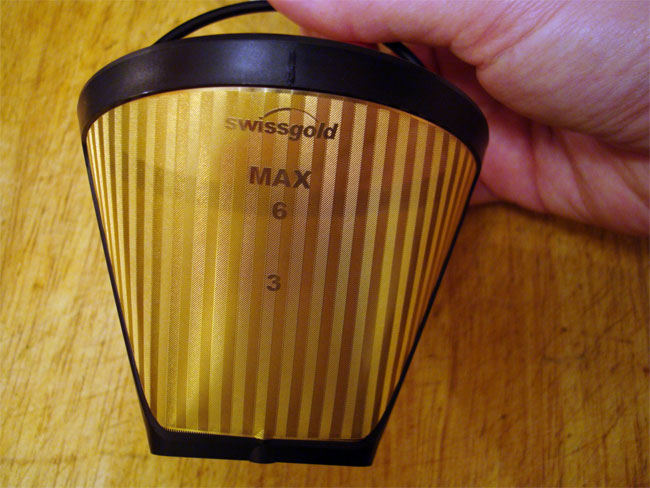
One of the coffee-related gifts we gave ourselves this Christmas is a Swissgold filter basket. While gold isn't chemically inert, it doesn't react with the colloidal* flavour particles in the coffee. A paper filter absorbs them, but this one lets them through.

Some people like the extra particles and oils that the Swissgold filter allows into your brew, but others don't.

We have tested this filter against two kinds of paper filters and with three different kinds of beans: Honduran, Nicaraguan and Costa Rican. We prefer the Honduran in the gold filter and the others in paper.


Gah. This is taking so long! I just want a cup of coffee, not a Wikipedia article!

The set-up: coffee pot, pour-over cone, filter basket. A ceramic pour-over cone would be nice, but it needs to be pre-heated and is not essential.

Grind dem beans, dem beans!


Grounds in the basket.

Pre-heat the pot in the microwave.

A folded towel insulates the scale against the hot coffee. Probably not an issue, but it also makes a firm base for the tower of equipment.

We use the i-Pod's built-in timer, but you can also get some helpful apps specifically made for brewing coffee. We started with a free one from Intelligentsia Coffee. They also have helpful brewing guides in the app and on-line (PDF). We did notice that they never actually say how many cups each method makes, which could lead to some embarrassing situations. This specific site is a great resource for brew methods, too.


Another coffee-specific Christmas gift to ourselves: a fancy-panty kettle with a spout designed for a slow, controlled pour. We have found that 455 grams of water ends up with just the right amount of water for our coffee if we take it off the boil right away.

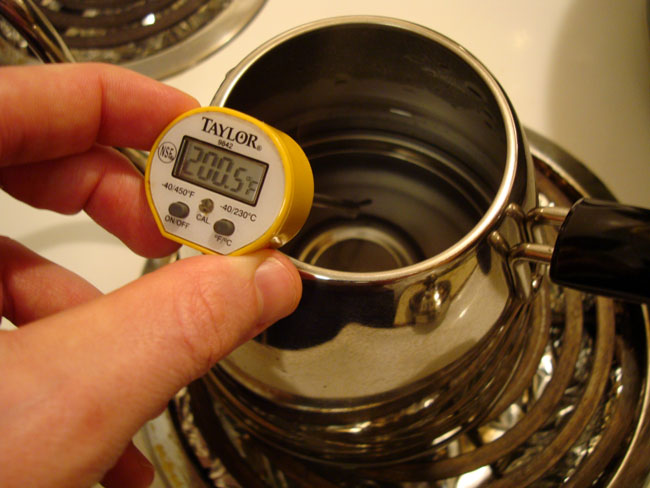
Most pour-over methods suggest a water temperature between 195 and 205 degrees Fahrenheit. This is one of the rare occasions where we prefer to use Fahrenheit since the smaller increments allow for greater control.

At last! Pouring the hot water! Only 65 grams to start, though; just enough to soak the grounds.

The "bloom" will rise and let the grounds release their CO2. Coffee that was roasted less than a week before needs to rest for at least 60 seconds at this point. Coffee older than 7 days can rest for less time, but not less than 30 seconds.

During the bloom/rest, the kettle is returned to a low burner, heating back up to the magic temperature range again.


When the bloom is finished we start the final pour: s-l-o-o-o-w-l-y, in circular motions, keeping the water level constant, soaking all the grounds and staying clear of the edges.

s-l-o-o-o-w-l-y
The pour should take two full minutes.

For 28 grams of coffee the added water should be about 415 grams. We poured a little too much here while fiddling with the camera. (We don't want to spoil the ending for you, but things worked out just fine.)

The Swissgold filter is a bit fragile, we hear, so we gently tap out the grounds before giving it a good rinse.


At long last, we pour from the pot into mugs that were pre-heated in the microwave.

Some people think that anything added to coffee adulterates the taste, but there are so many ways to enjoy it. We have it black for a week or two, then with a little milk or cream. Different beans and roasts show variations on their flavour profiles with each style. We have dropped sugar completely, however, and it's wonderful.

Now that we have this method down, do we do this every day? Absolutely not. We still love our little stove-top moka pot/caffettiera and a microwaved mug of milky instant coffee is a real pleasure.

The fun is in trying a new system and dialing in the variables and the process until you can get a reliable brew. Trying different beans and roasts is just like discovering new wines; when you get it right they reveal all kinds of wonderful flavours.

Not everyone is happy about the rise of the pour-over method, though, especially as a business model.


*Murano Glass is another example of a colloid, which coincidentally has gold chloride added to create its signature ruby colour.
Web Statistics